Shoreline Preservation

The County of Haliburton is fortunate to have many lakes and rivers that contribute environmentally, economically, and socially to the County. These lakes are home to a wide range of aquatic species, plants, and animals. They support a thriving tourism industry and provide a home for many residents. Additionally, the lakes offer countless recreational opportunities, including swimming, boating, and fishing.

The health of these lakes and rivers are essential for both residents and businesses. The Shoreline Preservation By-law seeks to strike a balance between the rights of shoreline property owners to use and enjoy their property, with the preservation of the natural environment, lake health and natural aesthetics.

The Shoreline Preservation By-law is designed to regulate situations where a property owner (or their representative) plans to make significant changes to the grade or topography of their property that could increase the flow of surface water onto neighboring lands or bodies of water.

It also applies when there is a proposal for the substantial removal of trees and/or vegetation. In these cases, property owners must apply for and obtain permit approval before proceeding with such major projects or activities within the shoreline buffer area.

Shoreline Permits

Click the tabs below for information on Shoreline Permits, or use the link below to self-screen to confirm whether or not you require a shoreline permit. 

Section 5 of By-law 4169 outlines exempted activities which do not require a shoreline permit; most common exemptions are:

  • Minor landscaping, being yard maintenance, installation of a small pathway, retaining walls less than 1 metre in height and landscaping which does not alter the grade or topography by greater than 0.3 metres.
  • Maintenance of existing landscape features, pathways, driveways and beaches including raking/weeding
  • Removing up to 25% of native vegetation (including trees) on residential lots from the shoreline.
  • Removal of dangerous trees which pose imminent threat to public health or property
  • Repair, or clearing of pathways (under 5 meters wide and requiring less than 25% shoreline vegetation removal).
  • Operation or maintenance of approved sewage treatment systems.
  • Constructing or repairing a shoreline structure with a proper building permit.
Shoreline permit applications are required for larger projects which do not meet the exemption criteria under section 5 of By-law 4169.

This includes:

  • Adding or removing fill that would change the grade more than 0.3 m 
  • Adding a retaining wall that is more than 1 metre in height
  • Clearing more than 25% of the shoreline
  • Creating pathways to the water that are more than 5 metres wide

If you are seeking to do shoreline work on your property and have questions about permitting, please contact the County's Planning Director, Elizabeth Purcell here: epurcell@haliburtoncounty.ca 

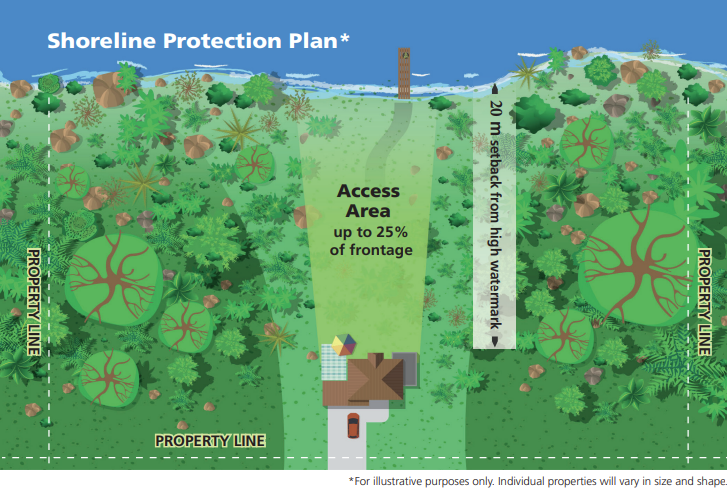
The image below illustrates shoreline area with the applicable 20-metre setback. It also provides an example of an allowable access area, where up to 25% of shoreline vegetation removal may occur. The County encourages property owners to minimize vegetation removal; however, up to 25% may be removed under an exemption.

Shoreline Protection Plan

If you're a property owner planning shoreline work, you can fill out the short self-assessment form below to help determine if you need a shoreline permit from the County

By-Law 4169, Shoreline Preservation Project Self-Screening Form

Vegetation and Natural Buffers

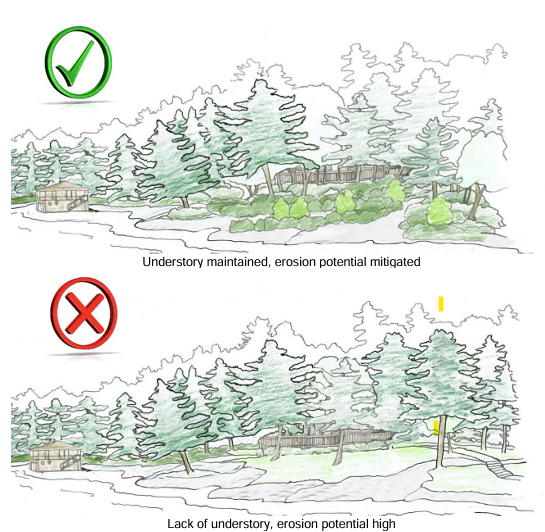
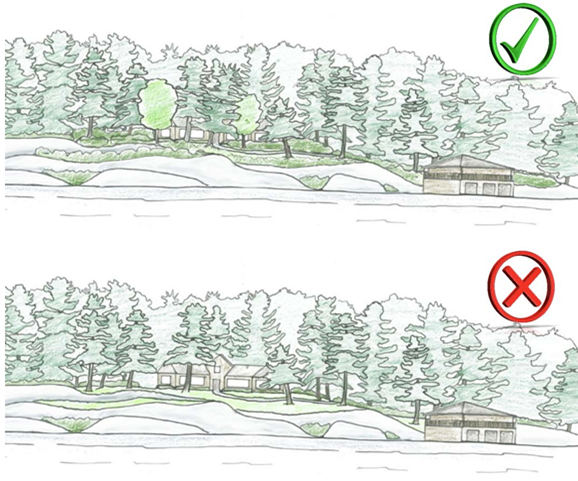
  • Preserve native vegetation along the shoreline. This helps stabilize soil, filters runoff and provides habitat.
  • Minimize clearing; only remove what is necessary for reasonable access or safety
  • Keep the understory; low lying plants also provide excellent erosion control


Erosion Control

  • Avoid hard surfaces when possible, like rock retaining walks or patios, use soft engineering
  • Create and maintain gradual slopes rather than steep banks
  • Plant deep rooting native vegetation
  • Do not remove tree stumps when possible if trees need to be removed

Runoff and Pollution

  • Limit fertilizer and pesticide use near shorelines
  • Direct stormwater away from the lake; try installing a rain garden
  • Use permeable materials for pathways or driveways to reduce runoff

Construction and Access

  • Minimize disturbance during shoreline work; follow all local municipal permitting requirements
  • Limit access points to reduce vegetation damage; consider doing work in the fall when the water is low
  • Removing an old structure? Consider revegetating the area it once occupied.

Septic Systems and Wastewater

  • Regularly maintain septic systems to prevent leaching into the water
  • Keep septic systems as far from the water as possible; follow local municipal permitting requirements.

Shoreline Land Use and Design

  • Avoid lawns right up to the water’s edge, grass has shallow roots and can contribute to erosion and runoff
  • Use low-impact landscaping
  • Cluster development away from the shoreline to preserve larger natural areas and create a shoreline buffer

Frequently Asked Questions

A shore road allowance is a strip of land 20 metres (66 feet) deep measured from the water's edge which separates waterfront properties from the lake. SRAs were originally established on crown land to facilitate activities such as logging, and many still exist.

Unless title of the shore road allowance has been purchased by a property owner, it remains under the ownership of the local Township. Ownership information is typically found in the legal description of the deed of land for your property and can be confirmed by your solicitor.

By-law 4169 has an extensive list of exempted activities listed under Section 5. If a proposed activity does not meet the criteria for an exemption under section 5, then a permit application would be required. Please contact the Shoreline Bylaw Permit Administrator with questions about permitting.

High water mark is the line where the land meets the water at a normal controlled level. High water mark can only be officially indicated by an Ontario Land Surveyor, or on a Plan of Survey.

However, there are physical indicators that can give you a reasonable estimate of the location of the high-water mark. Water and pollen stains are typically left on hard surfaces such as rocks and logs, which can help indicate high water mark. Changes in the type or texture of soil, or erosion or undercutting of banks can also help indicate high water mark.

Vegetation is considered the collection of plant species and the ground cover they provide, being all greenery including grasses, shrubs, weeds herbs and trees.

Yes. Existing structures can remain be renovated or rebuilt with appropriate building permits from your local municipality.

Existing structures built on the shore with proper approvals can be appropriately maintained. Rocks/stones and materials may be replaced without a permit, so long as material type is not changing. Additions, extensions or major alterations to such structures require review by the County.

The Director is required to issue a Shoreline Permit application within 30 days or provide reasoning if a permit is denied.

No. Property owners can continue to cut grass, remove weeds and maintain their waterfront yards. Property owners are encouraged to preserve and protect natural vegetation within the 20 metre shoreline area. Minor landscaping that does not change topography or water flow does not require a permit. Landscaping with native plants is better for the environment and easier to maintain.

A larger project is one that:

  • changes the natural grade of shoreline by more than 0.3 metres (1 foot) through the addition or removal of fill;
  • reduces shoreline vegetation by more than 25%; and/or,
  • involves the reshaping of the topography of a property through blasting
  • involves the installation of a retaining wall greater than 1 metre in height

Other examples include larger lot grading activities, storm water management projects or shoreline stabilization. Property owners must contact County Staff for such projects.

Sparsely vegetated shorelines are treated the same as any other shoreline. However, with less vegetation the opportunity to remove vegetation is naturally lower. For example, owners are permitted to remove up to 25% of vegetation under exemption. Therefore, if you only have four trees on your shoreline, only one is permitted to be removed without applying for a permit.

Contact Us

Email: planning_services@haliburtoncounty.ca

Phone: 705-286-1333

In-Person: 11 Newcastle Street, Minden, Ontario (Note: we recommend calling or emailing to make an appointment to ensure an appropriate staff member is available to help.)